
📚 Table of Contents
- How Facebook Ads Algorithm Works – Introduction
- What Is the Facebook Ads Algorithm?
- How Facebook Ads Algorithm Works Behind the Scenes
- Facebook Ads Auction System Explained
- Key Ranking Signals Used by Facebook Ads Algorithm
- How Facebook Ads Algorithm Works for Targeting
- Role of Engagement, Relevance & Quality Score
- How Facebook Ads Algorithm Works for Budget & Bidding
- Machine Learning & AI in Facebook Ads Algorithm
- Common Myths About Facebook Ads Algorithm
- Proven Strategies to Win the Facebook Ads Algorithm
- Internal & External Resources
- Final Conclusion
1️⃣ How Facebook Ads Algorithm Works – Introduction
How Facebook ads algorithm works is one of the most searched yet misunderstood topics in digital marketing today.
Many advertisers believe that increasing budget automatically improves performance. In reality, Facebook relies on a complex AI-powered algorithm that decides which ad to show, to whom, and at what cost—all in real time.
Understanding how Facebook ads algorithm works helps you:
- Lower cost per click (CPC)
- Improve conversion rates
- Scale campaigns efficiently
- Avoid wasted ad spend
This guide explains everything in simple, practical language—perfect for beginners, marketers, and business owners.
according to the Datascientest.Have you ever seen an ad on your Facebook or Instagram feed that relates to your passion, sporting activity or interests? It’s perfectly normal. Meta (the parent company of Facebook and Instagram) offers today’s most personalized advertising experience. With over 15 million active ad campaigns on the planet every day, Facebook is the world’s second largest ad provider (after Google). But how is a specific ad selected by the Facebook Ads algorithm to be shown to a user? How does Facebook sort advertisers and manage bids from different companies wishing to show their ads? In short, how does the Facebook Ads algorithm work? Answers in this article.
2️⃣ What Is the Facebook Ads Algorithm?
The Facebook Ads Algorithm is an automated decision-making system developed by Facebook (Meta Platforms).
Its core purpose is to:
Deliver the most relevant ad to each user while maximizing advertiser and user satisfaction.
The algorithm constantly analyzes:
- User behavior
- Ad quality
- Engagement patterns
- Historical performance
3️⃣ How Facebook Ads Algorithm Works Behind the Scenes
Every time a user scrolls Facebook or Instagram, the algorithm evaluates thousands of ads in milliseconds.
🔍 Core Objective of the Algorithm
- Improve user experience
- Show ads users care about
- Reward high-quality advertisers
This means advertisers who understand how Facebook ads algorithm works always gain a competitive advantage.
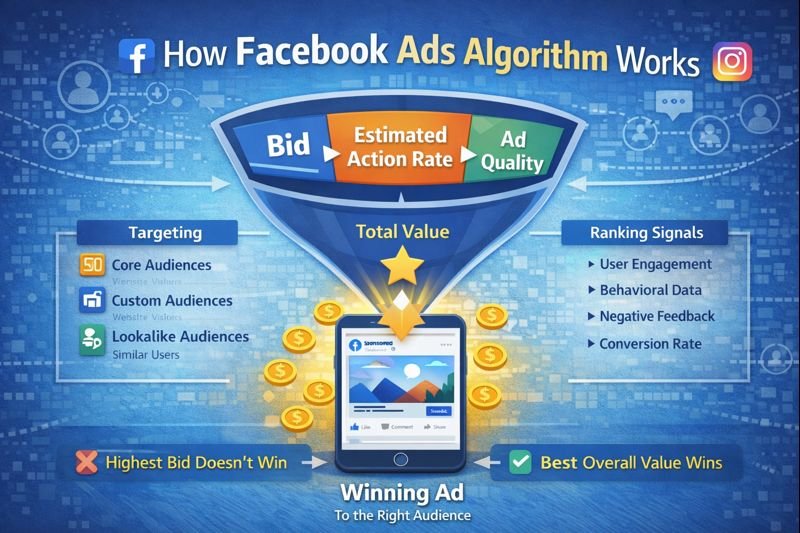
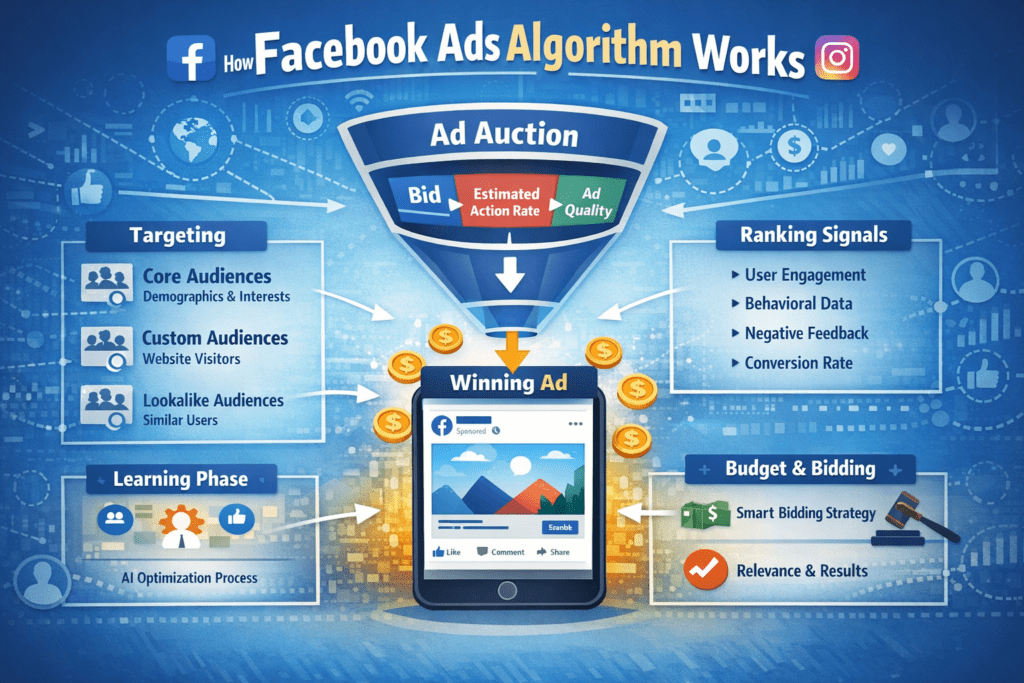
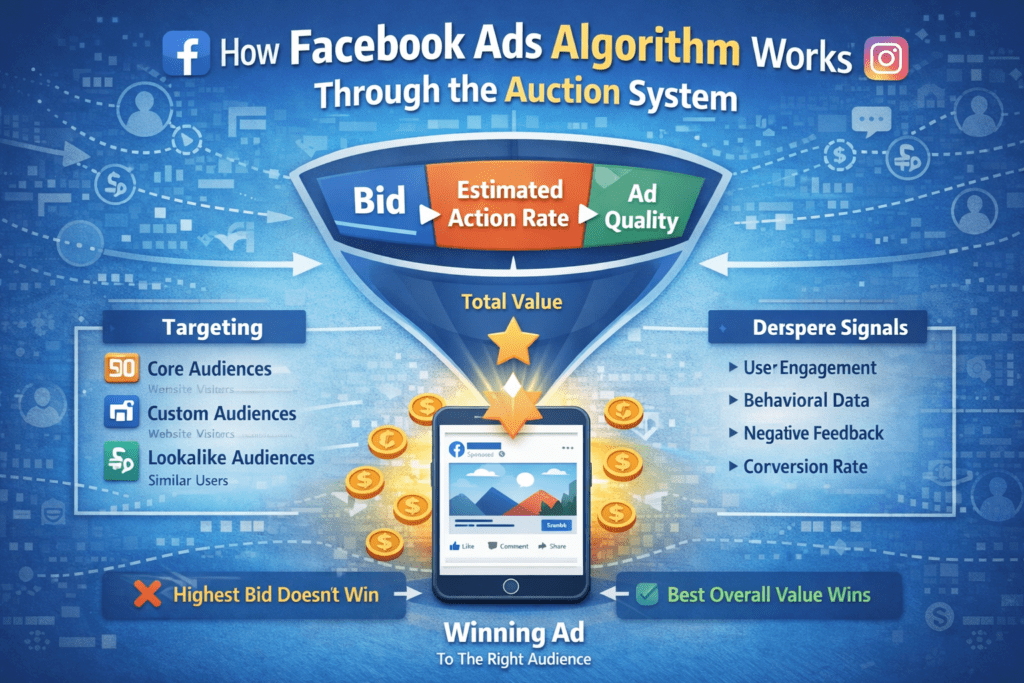
4️⃣ How Facebook Ads Algorithm Works Through the Auction System
Facebook Ads do not have fixed pricing.
Instead, each ad competes in a real-time auction.
🏆 The Auction Is Based On 3 Factors
1. Bid
How much you are willing to pay.
2. Estimated Action Rate
How likely a user is to:
- Click
- Watch
- Convert
3. Ad Quality
User feedback, engagement, and relevance.
👉 Highest bid doesn’t always win.
The best overall value does.
5️⃣ Key Ranking Signals Used by Facebook Ads Algorithm
🔹 User Interest Matching
Ads aligned with interests perform better.
🔹 Engagement History
Likes, comments, shares, saves, and video views.
🔹 Behavioral Signals
Search activity, app usage, and purchase intent.
🔹 Negative Feedback
Hidden ads, reports, or low engagement reduce delivery.
6️⃣ How Facebook Ads Algorithm Works for Targeting
Facebook Ads Algorithm matches ads with users using:
🎯 Audience Types
Core Audiences
- Age
- Gender
- Location
- Interests
Custom Audiences
- Website visitors
- App users
- Customer lists
Lookalike Audiences
- Users similar to your best customers
💡 Best Practice:
Use broad targeting and let the algorithm optimize delivery.
7️⃣ Role of Engagement, Relevance & Ad Quality
Although Facebook removed public relevance scores, the algorithm still evaluates:
- Quality Ranking
- Engagement Rate Ranking
- Conversion Rate Ranking
✅ High-Quality Ads Include:
- Clear messaging
- Scroll-stopping creatives
- Honest landing pages
- Fast website load speed
8️⃣ How Facebook Ads Algorithm Works for Budget & Bidding
The algorithm:
- Allocates budget to high-performing users
- Reduces delivery to low-quality placements
- Optimizes bids dynamically
🔥 Smart Bidding Types
- Lowest Cost
- Cost Cap
- Bid Cap
For beginners, Lowest Cost bidding works best.
9️⃣ Machine Learning & AI in Facebook Ads Algorithm
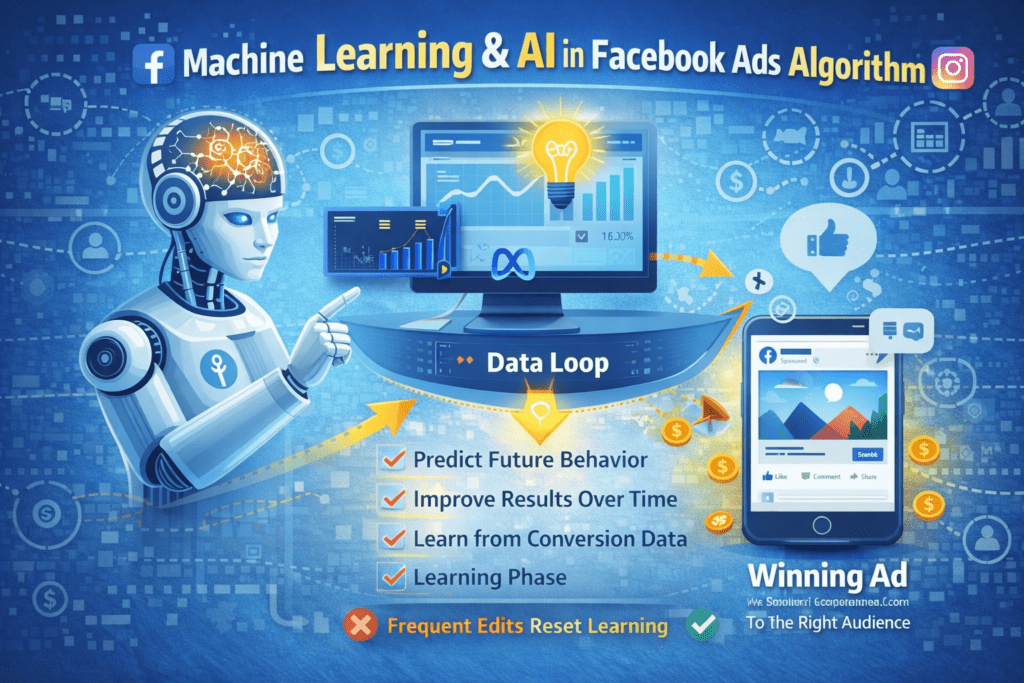
Facebook Ads Algorithm uses machine learning to:
- Predict future behavior
- Improve results over time
- Learn from conversion data
📌 This is why campaigns need a learning phase.
Avoid frequent edits—let the AI learn.
🔟 Common Myths About Facebook Ads Algorithm
❌ Bigger budget guarantees success
❌ Narrow targeting works best
❌ High bids always win
❌ Algorithm hates new accounts
✅ Truth: Ad quality + relevance wins.
1️⃣1️⃣ Proven Strategies to Win the Facebook Ads Algorithm
✔ Use High-Quality Creatives
✔ Optimize for Conversions
✔ Allow Learning Phase Completion
✔ Test Multiple Ad Variations
✔ Use Video & Reels Ads
✔ Track Conversions Properly
1️⃣2️⃣ Internal & External Resources
🔗 Internal Links (Example)
- How Facebook Ads Work
- Facebook Ads Cost Explained
- Meta Ads vs Google Ads
🌐 DoFollow External Links
- Facebook Ads Help Center
- Meta Business Blog
1️⃣3️⃣ Final Conclusion
Understanding how Facebook ads algorithm works is essential for modern digital marketing success.
The algorithm rewards:
- Relevance
- Value
- User satisfaction
If you focus on quality over budget, Facebook Ads can become your most powerful growth engine.
🔍 Deeper Understanding: Why How Facebook Ads Algorithm Works Matters More Than Ever
In today’s highly competitive digital landscape, understanding how Facebook ads algorithm works is no longer optional—it’s a survival skill. With millions of advertisers competing for limited user attention, the algorithm acts as a gatekeeper. Only ads that align with user intent, platform goals, and quality standards are rewarded with consistent delivery and lower costs.
Facebook’s parent company, Meta Platforms, prioritizes long-term user experience over short-term advertiser revenue. This means advertisers who attempt to “hack” the system using misleading creatives or clickbait strategies often face higher costs, reduced reach, or even ad account restrictions.
🧠 How Facebook Ads Algorithm Works with User Psychology
One of the most overlooked aspects of how Facebook ads algorithm works is its deep connection with human behavior and psychology.
The algorithm tracks:
- Scroll speed
- Pause time on posts
- Replays of videos
- Comment sentiment
- Profile interactions
If users stop scrolling for your ad—even without clicking—it sends a positive relevance signal. Over time, Facebook learns which creatives emotionally resonate with specific audience segments.
🔑 Key Insight
Ads that feel native, helpful, and emotionally relevant outperform overly sales-driven ads.
📊 How Facebook Ads Algorithm Works with Conversion Events
The algorithm becomes significantly more powerful once it has conversion data.
When you optimize campaigns for:
- Purchases
- Leads
- Add to cart
- App installs
Facebook’s AI starts identifying patterns:
- Which age group converts best
- Which placement performs better
- Which creative drives action
This is why experts recommend installing and properly configuring the Meta Pixel.
Without conversion data, the algorithm is essentially guessing.
⚙️ How Facebook Ads Algorithm Works During the Learning Phase
Every new ad set enters a Learning Phase, where Facebook tests your ad across different audiences, placements, and behaviors.
During this phase:
- Costs may fluctuate
- Results may seem inconsistent
- Performance should not be judged prematurely
💡 Best Practice
Allow at least 50 optimization events before making major changes. Frequent edits reset the learning phase and confuse the algorithm.
This is a critical part of understanding how Facebook ads algorithm works efficiently.
📈 How Facebook Ads Algorithm Works with Placements
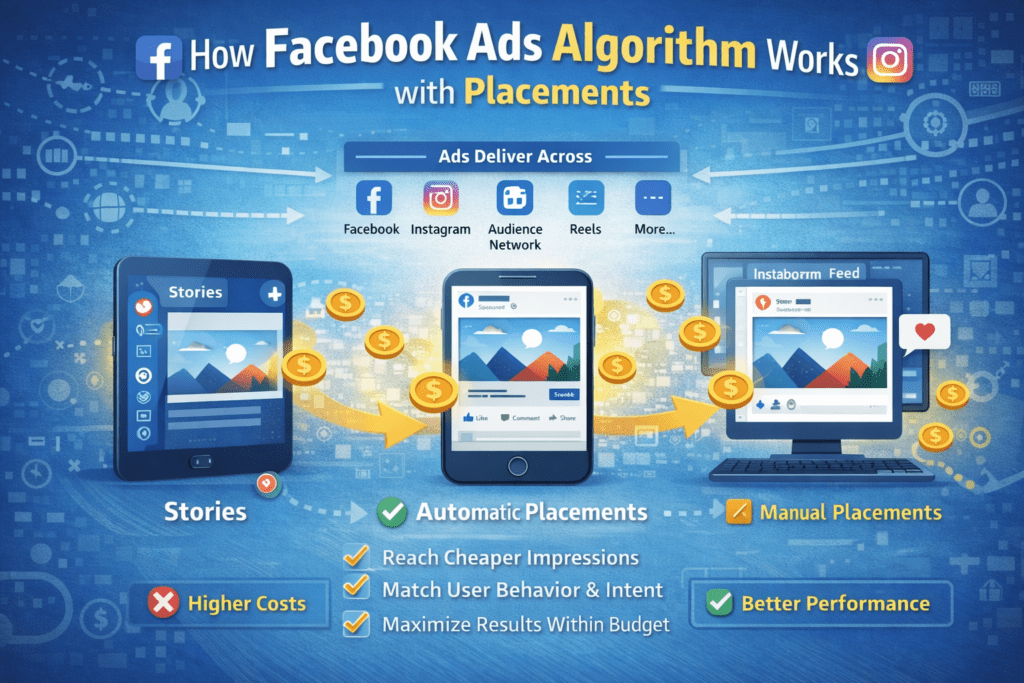
Facebook automatically distributes ads across:
- Facebook Feed
- Instagram Feed
- Stories
- Reels
- Audience Network
Unless you have strong data, Automatic Placements usually perform better. Why?
Because the algorithm:
- Finds cheaper impressions
- Matches placement with user behavior
- Maximizes results within your budget
Manual placements restrict the algorithm and often increase costs unnecessarily.
🎨 Creative Fatigue & Algorithm Performance
Another advanced concept in how Facebook ads algorithm works is creative fatigue.
When users see the same ad repeatedly:
- Engagement drops
- Negative feedback increases
- Costs rise
Signs of Creative Fatigue:
- Declining CTR
- Rising CPC
- Falling relevance rankings
🔄 Solution
Rotate creatives every 2–3 weeks and test:
- New hooks
- Different formats (video, carousel, reels)
- Fresh copy angles
📱 How Facebook Ads Algorithm Works for Video Ads
Video ads receive preferential treatment in the algorithm.
Why?
- Higher engagement
- Longer session times
- Better storytelling
Algorithm-Friendly Video Tips:
- Hook in first 3 seconds
- Use captions
- Keep videos under 30 seconds
- Design for mobile-first viewing
Reels and short-form videos currently receive higher organic and paid reach, making them ideal for algorithm optimization.
🔄 Retargeting & How Facebook Ads Algorithm Works
Retargeting audiences behave differently from cold audiences.
The algorithm understands that:
- Warm users convert faster
- Fewer impressions are needed
- CPA is naturally lower
This allows Facebook to:
- Spend budget more efficiently
- Increase conversion probability
- Shorten the learning curve
A balanced funnel with cold + warm + hot audiences aligns perfectly with how Facebook ads algorithm works.
🧪 A/B Testing & Algorithm Learning
A common mistake advertisers make is testing too many variables at once.
To help the algorithm learn:
- Test one variable at a time
- Creative
- Headline
- CTA
- Audience
Facebook’s built-in A/B Testing tool ensures fair distribution and cleaner data.
The more structured your testing, the faster the algorithm improves results.
🔐 Policy Compliance & Algorithm Trust Score
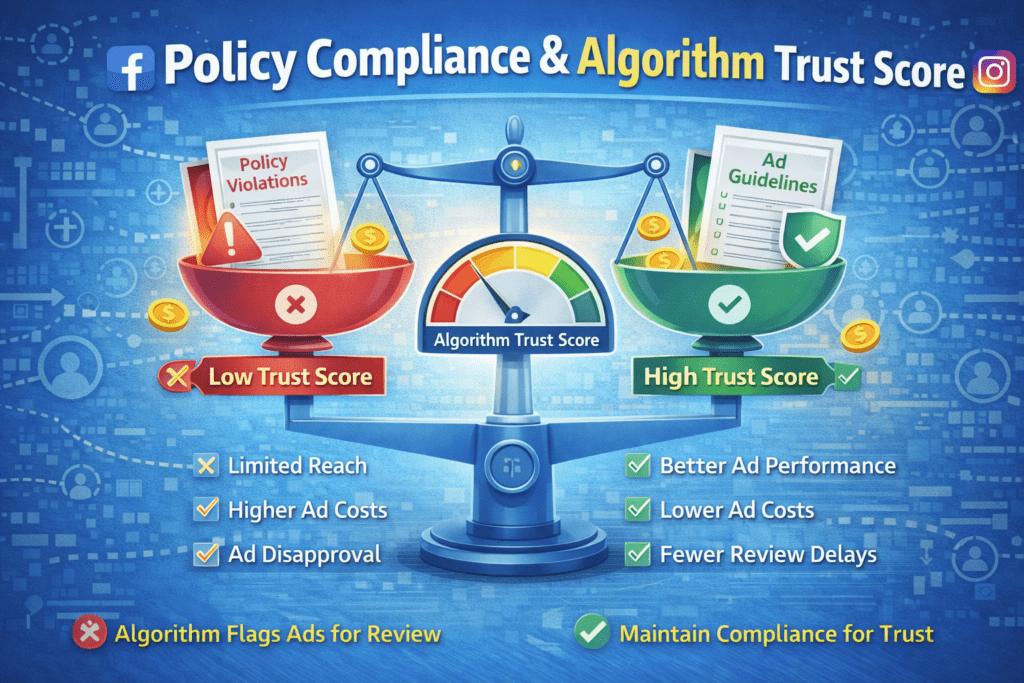
Ads that violate policies—even slightly—lose algorithmic trust.
Common issues include:
- Over-promising results
- Before/after images
- Misleading claims
- Personal attribute targeting
Accounts with consistent compliance enjoy:
- Faster approvals
- Better reach
- Lower CPMs
Trust is an invisible but powerful factor in how Facebook ads algorithm works.
🌍 Scaling Campaigns the Right Way
When scaling:
- Increase budgets gradually (20–30%)
- Duplicate winning ad sets instead of editing
- Expand audiences instead of narrowing
Aggressive scaling shocks the algorithm and often destroys performance.
Slow, data-driven scaling aligns with how Facebook ads algorithm works sustainably.
🔗 Expanded Internal & External Resources
🔗 Internal Links (Recommended)
- Complete Guide: How Facebook Ads Work
- Facebook Ads Cost Breakdown
- Meta Ads Funnel Strategy
🌐 DoFollow External Links (Recommended)
- Facebook Ads Help Center
- Meta Business Blog
- Meta Blueprint Courses
(Use these as DoFollow links on your website for SEO authority.)
🏁 Expanded Final Conclusion
Understanding how Facebook ads algorithm works gives you control, clarity, and confidence.
The algorithm is not your enemy—it’s your biggest ally when used correctly.
Facebook rewards advertisers who focus on:
- User value
- High-quality creatives
- Honest messaging
- Data-driven decisions
If you respect the system and optimize strategically, Facebook Ads can become a predictable, scalable, and profitable growth channel for your business.
How Facebook Ads Charge: 10 Powerful Truths About Facebook Ad Costs You Must Know click now.
Leave a Reply